- 15+ years combined home healthcare experience
- Background-verified clinical staff
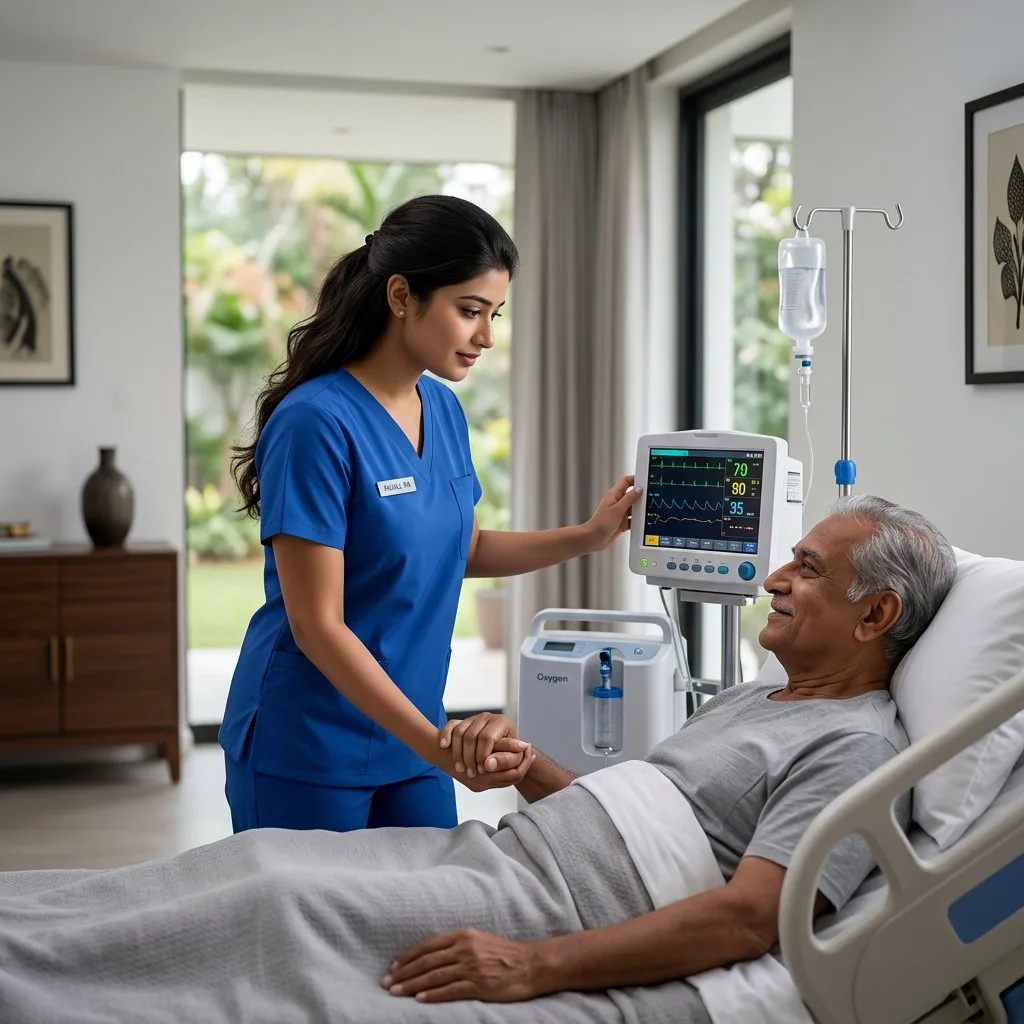
Medca Healthcare provides ventilator care at home in Bangalore with critical care-trained nurses managing invasive and non-invasive ventilation, alarm response, humidification, tracheostomy integration, weaning protocols, and 24/7 respiratory monitoring with physician-coordinated emergency escalation.
Medical overview
Medca Healthcare delivers expert ventilator care at home in Bangalore for patients requiring ongoing mechanical ventilation, non-invasive BiPAP or CPAP support, or progressive weaning from hospital ventilator dependence. Home ventilation reduces hospital-acquired infection exposure, enables family participation, and significantly reduces the cost of prolonged ICU stays for chronically ventilator-dependent patients.
Ventilator management is among the most technically demanding home nursing specialties. Medca critical care nurses monitor ventilator parameters, respond to alarm conditions, manage humidification circuits, coordinate tracheostomy airway care, and execute physician-directed weaning protocols while maintaining emergency escalation readiness at all times.
Ventilator care is a cornerstone of our home nursing services, integrated with tracheostomy care, ICU-at-home, and enteral feeding in comprehensive critical care packages.
Symptoms & warning signs
- Respiratory failure requiring mechanical ventilation beyond hospital stay
- Neuromuscular disease — ALS, muscular dystrophy — with progressive ventilatory failure
- Obstructive sleep apnoea or COPD requiring nocturnal BiPAP support at home
- Prolonged ICU stay with slow ventilator weaning needing home transition
- Recurrent respiratory decompensation requiring intermittent ventilator support
- Tracheostomy-dependent ventilation with complex airway and secretion management
Common causes
- Chronic respiratory failure from COPD, interstitial lung disease, or neuromuscular conditions
- Prolonged mechanical ventilation after sepsis, trauma, or neurological catastrophe
- ALS and progressive neuromuscular disease with diaphragmatic failure
- Severe obesity hypoventilation syndrome requiring BiPAP at home
- Post-COVID or post-ARDS lung injury with prolonged ventilator dependence
Risk factors
- Power failure without adequate UPS and generator backup at home
- Inadequate humidification causing airway obstruction and ventilator asynchrony
- Unqualified personnel adjusting ventilator settings causing barotrauma or hypoventilation
- Delayed emergency response when ventilator-dependent patient desaturates
- Equipment malfunction without biomedical support contract
Who needs this service
- Patients cleared by intensivist or pulmonologist for home ventilator management
- Individuals with established tracheostomy on stable ventilator settings
- BiPAP-dependent patients requiring nursing supervision for compliance and monitoring
- Families with adequate home infrastructure — space, power, oxygen backup
- Patients with defined physician oversight and emergency hospital transfer plan
When higher-level clinical care is required
- Acutely unstable ventilator patients still requiring in-hospital intensivist management should not transition home prematurely.
- Patients needing only occasional oxygen supplementation without ventilator dependence should use standard nursing or caregiver services.
- Home environments without reliable power backup are unsafe for ventilator-dependent patients without infrastructure modification.
Why choose Medca Healthcare
Key benefits
- ICU-Trained Ventilator Nurses
- 24/7 Respiratory Monitoring
- BiPAP & Invasive Ventilation
- Bangalore Home Setup
- Weaning Protocol Support
- Emergency Escalation Ready
Clinical care process
- 1 Pulmonologist or intensivist clearance for home ventilator transition.
- 2 Home infrastructure assessment — power, space, oxygen, suction, biomedical setup.
- 3 Ventilator equipment procurement, installation, and alarm testing with biomedical vendor.
- 4 Critical care nurse team assignment with 24/7 shift rotation schedule.
- 5 Emergency protocol documentation including manual ventilation and ambulance transfer.
- 6 Daily physician communication with ventilator settings and weaning progress reports.
Treatment support & care scope
Clinical & daily care support
- Ventilator parameter monitoring — mode, FiO2, PEEP, tidal volume, respiratory rate
- Alarm assessment and response — high pressure, low pressure, apnea, disconnect
- Humidification circuit management and HME filter replacement
- Integrated tracheostomy suctioning and airway care during ventilator support
- ABG trend coordination and SpO2 continuous monitoring documentation
- Physician-directed weaning trials with spontaneous breathing assessment
- Emergency manual ventilation with ambu bag during equipment failure events
Related conditions
- ALS home ventilation with progressive disease management
- Post-ICU prolonged ventilator weaning at home
- Paediatric-adult transition ventilator care for young adults with congenital conditions
- COPD home BiPAP with nursing compliance and monitoring support
- Tracheostomy-ventilator integrated care in ICU-at-home packages
- Nocturnal BiPAP for obesity hypoventilation and severe OSA
- Respiratory Failure
- ALS
- COPD
- Tracheostomy Ventilation
- BiPAP Therapy
Recovery guidance & expected outcomes
- Biomedical equipment preventive maintenance scheduling
- Family orientation on alarm recognition without adjusting ventilator settings
- Oxygen supply coordination and cylinder backup inventory management
- Pulmonary rehabilitation exercise support during weaning phases
- Coordination with ENT for tracheostomy tube changes during ventilator support
Care team & availability
- 8-hour and 12-hour critical care nursing rotations 24/7 for invasive ventilation
- Night BiPAP supervision shifts for compliance-dependent non-invasive ventilation
- Weaning trial shifts with extended nurse presence during SBT periods
- On-call biomedical and nursing emergency response for equipment alarms
Emergency signs — seek immediate help
- Ventilator disconnect or power failure without immediate backup activation
- High-pressure alarm unresponsive to suctioning — possible tube obstruction or pneumothorax
- Sudden desaturation below 85% unresponsive to FiO2 increase and suctioning
- Patient-ventilator asynchrony with respiratory distress and use of accessory muscles
- Barotrauma signs — subcutaneous emphysema, sudden chest pain, unilateral breathlessness
- Cardiac arrest requiring immediate CPR, manual ventilation, and emergency services
Caregiver & family guidance
Never adjust ventilator settings, FiO2, or alarm limits without nurse or physician direction. Know the location of the ambu bag and how to call for nursing help. Test UPS and generator backup weekly. Do not disconnect the ventilator circuit unnecessarily. Report any change in breathing pattern, secretions, or skin colour immediately.
Medical highlights
Medca Healthcare home ventilator nursing in Bangalore delivers critical care nurse management of mechanical ventilation, BiPAP/CPAP therapy, tracheostomy-integrated ventilator care, weaning protocols, and continuous respiratory monitoring with equipment setup and emergency escalation for ventilator-dependent patients.
- Critical care-trained nurses with hospital ICU ventilator experience.
- Invasive and non-invasive ventilation management at home.
- 24/7 nursing shift coverage with structured ventilator handover.
- Equipment setup, biomedical coordination, and power backup requirements.
- Physician-directed weaning protocols with structured progress documentation.
Sub-services
-
Airway Care
Medca Healthcare delivers premium Airway Care solutions, combining clinical expertise with personalized patient care in the comfort of your...
-
Critical Care Support
Medca Healthcare delivers premium Critical Care Support solutions, combining clinical expertise with personalized patient care in the comfor...
-
Ventilator Monitoring
Medca Healthcare delivers premium Ventilator Monitoring solutions, combining clinical expertise with personalized patient care in the comfor...
Frequently asked questions
- Can ventilator patients live at home safely?
- Yes, with critical care nurses, proper equipment, power backup, physician oversight, and emergency protocols — for patients cleared by their intensivist.
- What ventilator modes can be managed at home?
- Most stable modes — AC, SIMV, PSV, BiPAP — can be managed home with ICU-trained nurses following physician orders.
- How much does home ventilator care cost compared to ICU?
- Home care is typically significantly less expensive for prolonged ventilator dependence, though equipment rental and 24/7 nursing remain substantial investments.
- Is BiPAP the same as ventilator care?
- BiPAP is non-invasive ventilation. Our nurses manage both invasive tracheostomy ventilation and non-invasive BiPAP/CPAP at home.
- What power backup is required?
- UPS for immediate backup and generator for extended outages are essential. Medca assesses infrastructure during home feasibility evaluation.
- Can ventilator-dependent patients ever wean off?
- Some can with structured weaning protocols. ALS and progressive neuromuscular patients may require lifelong support — we plan accordingly.
- Who adjusts ventilator settings at home?
- Only the treating pulmonologist or intensivist adjusts settings. Nurses implement changes and monitor response — they do not independently modify parameters.
- Does ventilator care include tracheostomy management?
- Yes. Invasive home ventilation integrates tracheostomy suctioning, stoma care, and tube change coordination in unified nursing plans.
Medical information & trust
- Content author
- Medca Healthcare Clinical Content Team
- Medical reviewer
- Medca Healthcare
- Last reviewed
- August 7, 2026
- Last updated
- September 1, 2026
- Contact
- +91 8884 999 001 · SLN Complex, 2nd Floor, Arekere Gate, Bannerghatta Road, Bengaluru, Karnataka 560076
This page provides general medical information about home healthcare services and is not a substitute for emergency care or a direct medical consultation. Call emergency services (108/112) for life-threatening symptoms.